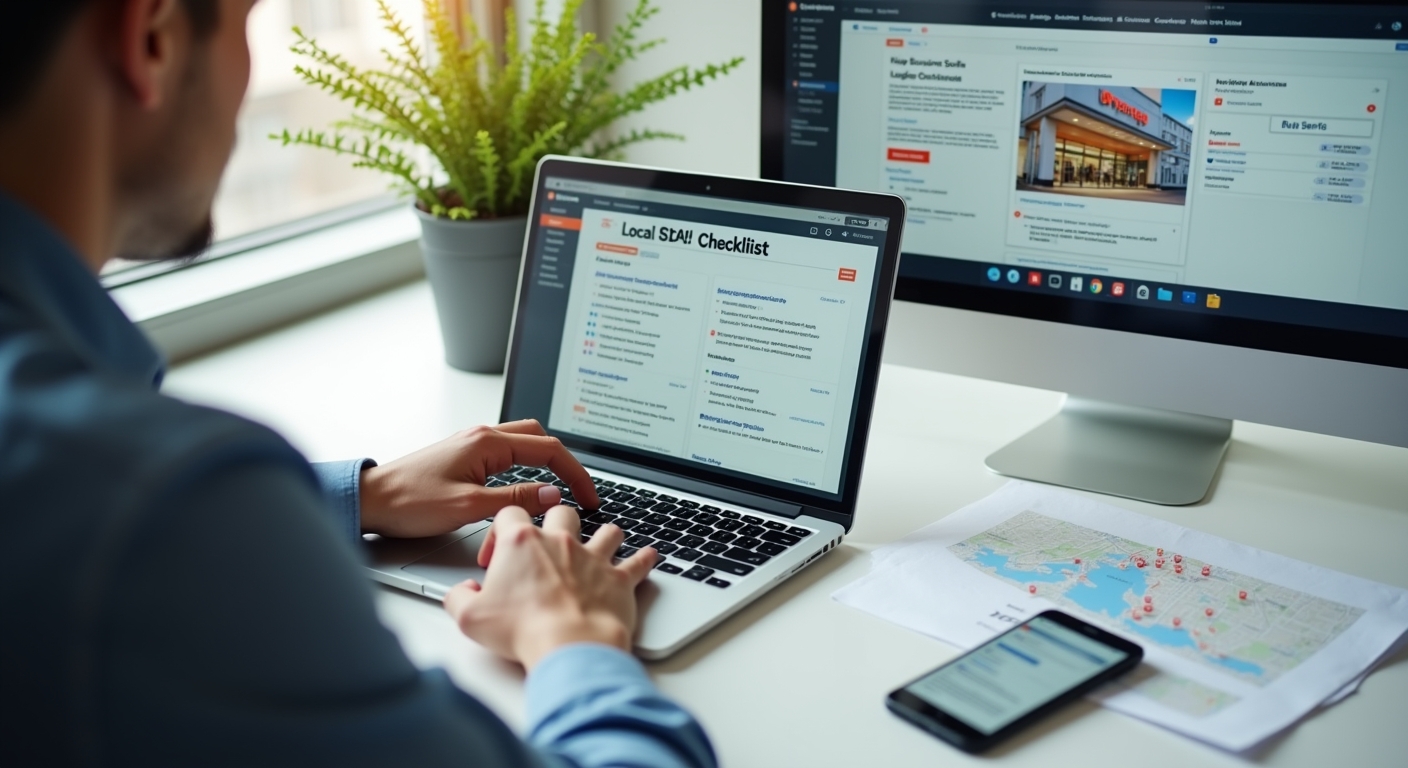
A strong local SEO checklist Malaysia helps SMEs appear in Google Search and Google Maps when nearby customers are ready to buy. The essentials are simple: set up your Google Business Profile properly, keep your business details consistent, optimise local pages on your website, earn reviews, and track local leads. If you want the wider strategy behind these tasks, see these marketing guides for Malaysian businesses.
A practical local SEO checklist for Malaysian SMEs should cover Google Business Profile setup, NAP consistency, local keyword targeting, location pages, schema markup, customer reviews, citations, local backlinks, and performance tracking. Done consistently, these steps improve visibility in Google Maps, local search, and the map pack.
- Claim and verify your Google Business Profile
- Standardise your business name, address, and phone number
- Choose accurate business categories
- Add hours, service areas, and attributes
- Target city- and service-based keywords
- Optimise title tags, meta descriptions, and headings
- Create dedicated service and location pages
- Add local business schema markup
- Improve mobile speed and usability
- Keep NAP consistent across directories
- Build citations on relevant Malaysian listings
- Collect and reply to customer reviews
- Post photos, products, and updates
- Earn local backlinks and mentions
- Track rankings, clicks, calls, and leads
What Is a Local SEO Checklist for Malaysian SMEs?
A local SEO checklist is a structured list of tasks that helps a business improve visibility for local searches such as “accountant in Shah Alam” or “cafe near me”. For Malaysian SMEs, it focuses on the ranking factors that influence Google Maps, local search results, and trust signals customers use before they contact a business.
Unlike general SEO, local SEO is tied to place. Google needs clear signals about where you operate, what you offer, and whether customers trust you. A checklist matters because most SMEs do not have time to audit every ranking factor from scratch. It turns local SEO into repeatable actions.
If you need a broader foundation before working through the checklist, this local SEO guide for Malaysian businesses is a useful companion resource.
Why Local SEO Matters for SMEs in Malaysia
Local SEO matters because many buying journeys start with a location-specific search. A customer looking for a dentist in Johor Bahru, a legal firm in Petaling Jaya, or a renovation contractor in Penang usually wants a nearby, credible option fast. If your business is not visible at that moment, a competitor gets the lead.
For Malaysian SMEs, local SEO is especially important because search behaviour is multilingual and mobile-first. Customers may search in English, Bahasa Melayu, or a mixed phrase. They also compare business hours, reviews, directions, and photos before they visit or call.
Good local SEO helps you:
- Show up in Google Maps and the map pack
- Capture high-intent local searches
- Build trust through reviews and complete profiles
- Drive more calls, visits, and form enquiries
- Compete with larger brands in specific local areas
It also supports digital adoption goals promoted by organisations such as MDEC, especially for SMEs trying to strengthen online discoverability in their own markets.
Local SEO Checklist Malaysia: Core Setup
Claim and verify your Google Business Profile
Your Google Business Profile is the foundation of local SEO for small business Malaysia. If it is unclaimed, incomplete, or unverified, your local visibility is capped.
Start by claiming the listing, verifying ownership, and checking that the public information matches your actual business details. Follow the official setup guidance in Google Business Profile Help.
Why this matters: Google relies on verified business data to decide whether your profile is trustworthy enough to show for local searches.
How to do it well:
- Use the real-world business details customers recognise
- Verify the listing as soon as possible
- Remove duplicates if they exist
- Make sure the primary website URL points to the correct page
For deeper setup tips, read how to use Google Business Profile effectively.
Use the correct business name, address, and phone number
Your NAP details must be accurate and consistent. Use your legal or real-world trading name, full address, and a working local phone number.
Why this matters: inconsistent business details confuse Google and customers. If one directory lists Suite 12 while another lists Unit 12, or one phone number is outdated, trust signals weaken.
How to do it well:
- Decide on one standard format for your business name and address
- Use the same format on your website, Google profile, and listings
- Update old citations if you have moved or changed numbers
- Check branch-specific details carefully if you have multiple outlets
Choose the right primary and secondary categories
Your business categories tell Google what you do. The primary category has a strong influence on which searches you can rank for, while secondary categories add useful context.
Why this matters: choosing a category that is too broad or inaccurate can reduce relevance. For example, a dental implant clinic should not default to a generic category if a more precise one is available.
How to do it well:
- Select the closest core category to your main revenue service
- Add secondary categories only when they reflect real services
- Avoid category stuffing
- Review categories if your business model changes
Add business hours, service areas, and attributes
A complete profile improves usability and trust. Add regular hours, holiday hours when relevant, service areas if you travel to customers, and attributes that help people decide.
Why this matters: local customers often compare businesses based on practical details first. Missing hours or unclear coverage can cost leads even if you rank well.
How to do it well:
- Keep opening hours updated
- Set service areas realistically if you are a service area business
- Add relevant attributes where available
- Review profile completeness every few months
Optimise Your Website for Local Search
Target Malaysian local keywords
Local keyword targeting means combining your services with places customers actually search for, such as “tax consultant Kuching” or “aircond service Subang Jaya”. Include both English and Malay language keywords where they fit naturally.
Why this matters: Google needs clear geo-targeted content to match your pages with local intent.
How to do it well:
- Use service + city, area, or neighbourhood phrases
- Consider branch-level variations if you serve multiple locations
- Include natural Malay variants when your customers use them
- Avoid stuffing every town name into one page
Optimise title tags, meta descriptions, and headings
Your key on-page SEO elements should reflect the page topic and location clearly.
Why this matters: title tags and headings help search engines and users understand what the page offers. Strong local relevance improves click-through and rankings.
How to do it well:
- Include the main service and location in the title tag
- Write a meta description that matches the page content
- Use one clear H1 and structured H2s
- Keep copy readable instead of repetitive
If you want a broader framework beyond local SEO, this SEO checklist for business owners can help.
Create location and service pages
If you serve different areas or offer distinct services, create dedicated pages instead of forcing everything into one generic page.
Why this matters: a page focused on one service in one market usually has a better chance of ranking than a broad page trying to target every place at once.
How to do it well:
- Create one page per core service
- Create location pages for branches or meaningful service areas
- Add useful local details, not copied templates
- Include contact details, directions, FAQs, and service proof where relevant
For a deeper approach, learn how to rank local service pages.
Add local business schema markup
Schema markup helps search engines understand your business details in a structured format. Common fields include business name, address, phone number, opening hours, and page type.
Why this matters: schema does not guarantee rankings, but it helps search engines interpret local data more confidently.
How to do it well:
- Use valid local business schema where appropriate
- Make sure schema matches visible page content
- Apply branch-specific details on branch pages
- Review structured data guidance on Google Search Central
Improve mobile speed and user experience
Many local searches happen on phones. If your website is slow, hard to read, or difficult to navigate, users leave before contacting you.
Why this matters: mobile usability affects both conversions and search performance indirectly through behaviour signals and crawl efficiency.
How to do it well:
- Use clear call buttons and contact options
- Make maps and addresses easy to access
- Compress images and reduce unnecessary scripts
- Keep forms short and easy to complete on mobile
Strengthen Local Trust Signals
Keep NAP details consistent across directories
NAP consistency means your business name, address, and phone number appear the same across your website, Google profile, social profiles, and business directories.
Why this matters: consistent data reinforces legitimacy. Mismatched listings create uncertainty around your business identity and branch information.
How to do it well:
- Audit your main listings manually or with a spreadsheet
- Correct outdated addresses, phone numbers, and URLs
- Use the same branch naming style everywhere
- Document the approved format for internal use
Build citations on relevant Malaysian business listings
Local citations are mentions of your business details on trusted directories and listing platforms. Focus on relevant Malaysian business directories and reputable niche listings.
Why this matters: citations support local trust and help search engines confirm your business presence.
How to do it well:
- Prioritise reputable, relevant directories
- Complete every listing fully
- Avoid low-quality, spammy directory submissions
- Make sure each listing links to the correct page or homepage
Collect and respond to customer reviews
Reviews are one of the clearest trust signals in local SEO. They influence rankings, click-through, and conversion decisions.
Why this matters: businesses with recent, credible reviews often look more active and trustworthy than those with outdated or no feedback.
How to do it well:
- Ask satisfied customers for reviews after a successful job or purchase
- Make the review process easy with a direct link
- Reply to positive and negative reviews professionally
- Never buy fake reviews
Example: a clinic with 80 recent, detailed reviews will usually earn more trust than one with 8 old reviews, even before a user clicks the website.
Add photos, products, and updates to your profile
Fresh profile content helps customers evaluate your business quickly. Add storefront photos, team photos, product images, and business updates when relevant.
Why this matters: visuals improve credibility, while profile updates show signs of an active business.
How to do it well:
- Use real, clear photos of your premises, team, and work
- Keep branding professional and current
- Add product or service highlights if the profile supports them
- Post updates when there is something useful to share
Build Local Authority
Earn backlinks from local organisations and associations
Backlinks from relevant local sources can strengthen your authority. Good examples include local chambers, industry associations, community organisations, event pages, and business partners.
Why this matters: local backlinks help Google understand your geographic and industry relevance.
How to do it well:
- Join relevant business associations
- Sponsor or support local events where appropriate
- Contribute expert insights to local publications
- Build partner pages or supplier mentions naturally
Publish locally relevant content
Geo-targeted content supports local search by showing you understand the questions and conditions in your market.
Why this matters: local content creates topical relevance that generic pages cannot match.
What to publish:
- Area-specific service guides
- Common customer questions by location
- Regulation or licensing explainers where relevant
- Local event or seasonal advice tied to your service
Example: a property management company could publish a guide on common maintenance issues for condos in specific Klang Valley areas.
Use social proof and case studies from Malaysian customers
Social proof can include testimonials, review excerpts, before-and-after project examples, and client success snapshots. If you use case studies, make them real and specific.
Why this matters: local prospects trust evidence from customers who look similar to them or operate in the same area.
How to do it well:
- Reference the customer’s location when permission is given
- Highlight the problem, solution, and result clearly
- Add visuals where appropriate
- Avoid vague claims without proof
Track Local SEO Performance
Monitor rankings in Google Maps and local search
Track whether your business is improving for important service and location queries.
Why this matters: local visibility can vary by area, device, and keyword. You need trend data, not guesses.
How to do it well:
- Track a core list of service + location keywords
- Check Google Maps visibility as well as organic rankings
- Review branch-level performance separately
- Look for drops after profile or website changes
Track calls, direction requests, and website clicks
Google Business Profile insights and website analytics can show how people engage with your listings and pages.
Why this matters: ranking is useful only if it leads to real actions.
Track metrics such as:
- Phone calls
- Direction requests
- Website clicks
- Contact form submissions
- WhatsApp enquiries, if used on site
Review conversions and leads from local traffic
Not all traffic has the same business value. Measure the quality of leads from local channels.
Why this matters: an SME may rank for many local terms but still attract weak leads if page messaging, location targeting, or service fit is wrong.
How to do it well:
- Review which pages generate actual enquiries
- Compare branch or city-level conversion performance
- Check whether mobile users convert properly
- Adjust underperforming pages based on lead quality
Common Local SEO Mistakes Malaysian SMEs Should Avoid
- Using different NAP details across platforms
- Choosing inaccurate Google Business Profile categories
- Creating thin location pages with copied text
- Ignoring reviews or replying unprofessionally
- Targeting only broad keywords without location intent
- Neglecting mobile usability
- Setting up a profile but never updating it
- Building low-quality directory links at scale
- Failing to track leads from local traffic
- Using one page to target too many cities or services
Most local SEO problems are not caused by one major error. They usually come from several small inconsistencies that weaken trust and relevance over time.
Final Local SEO Checklist for Malaysian SMEs
- Claim and verify your Google Business Profile
- Use the correct business name, address, and phone number
- Choose accurate primary and secondary categories
- Add business hours, service areas, and attributes
- Target Malaysian local keywords naturally
- Optimise title tags, meta descriptions, and headings
- Create focused service and location pages
- Add local business schema markup
- Improve mobile speed and user experience
- Keep NAP details consistent across the web
- Build citations on relevant Malaysian directories
- Collect and respond to customer reviews
- Add photos, products, and profile updates
- Earn local backlinks and publish local content
- Track rankings, clicks, calls, and leads
A local SEO checklist for Malaysian SMEs works best when treated as an ongoing process, not a one-time setup. Start with your profile and NAP consistency, then strengthen your website, reviews, citations, and local authority. The businesses that win local search usually do the basics better and more consistently than everyone else.
FAQ
What is local SEO for Malaysian SMEs?
Local SEO for Malaysian SMEs is the process of improving visibility in Google Search and Google Maps for location-based searches. It focuses on Google Business Profile optimisation, local keywords, reviews, citations, and location-focused website pages.
How do I optimise my Google Business Profile in Malaysia?
Claim and verify the profile, use accurate business details, choose the right categories, add hours and service areas, upload real photos, collect reviews, and keep the profile updated with relevant changes and posts.
What should be included in a local SEO checklist?
A local SEO checklist should include Google Business Profile setup, NAP consistency, category selection, local keyword targeting, on-page SEO, location pages, schema markup, citations, reviews, local backlinks, and performance tracking.
How long does local SEO take to show results in Malaysia?
It depends on your competition, website quality, and current profile strength. Some improvements such as profile completeness and review activity can help quickly, while stronger ranking gains often take several months of consistent work.
Do Malaysian SMEs need location pages for every branch?
Yes, if each branch serves a distinct location and has unique contact or service information. Each page should offer useful, original content rather than a copied template with only the city name changed.
How important are customer reviews for local SEO?
Very important. Reviews influence trust, click-through, and local rankings. Recent, genuine reviews with professional responses are more valuable than a large number of old or low-quality reviews.
Which Malaysian business directories help with local SEO?
The best directories are reputable, relevant listings that accurately display your business details. Focus on trusted general business directories, niche industry listings, association pages, and local platforms your customers actually use.
What is NAP consistency and why does it matter for local rankings?
NAP consistency means your business name, address, and phone number are the same across your website, Google Business Profile, and external listings. It matters because consistency helps search engines confirm that your business information is reliable.